


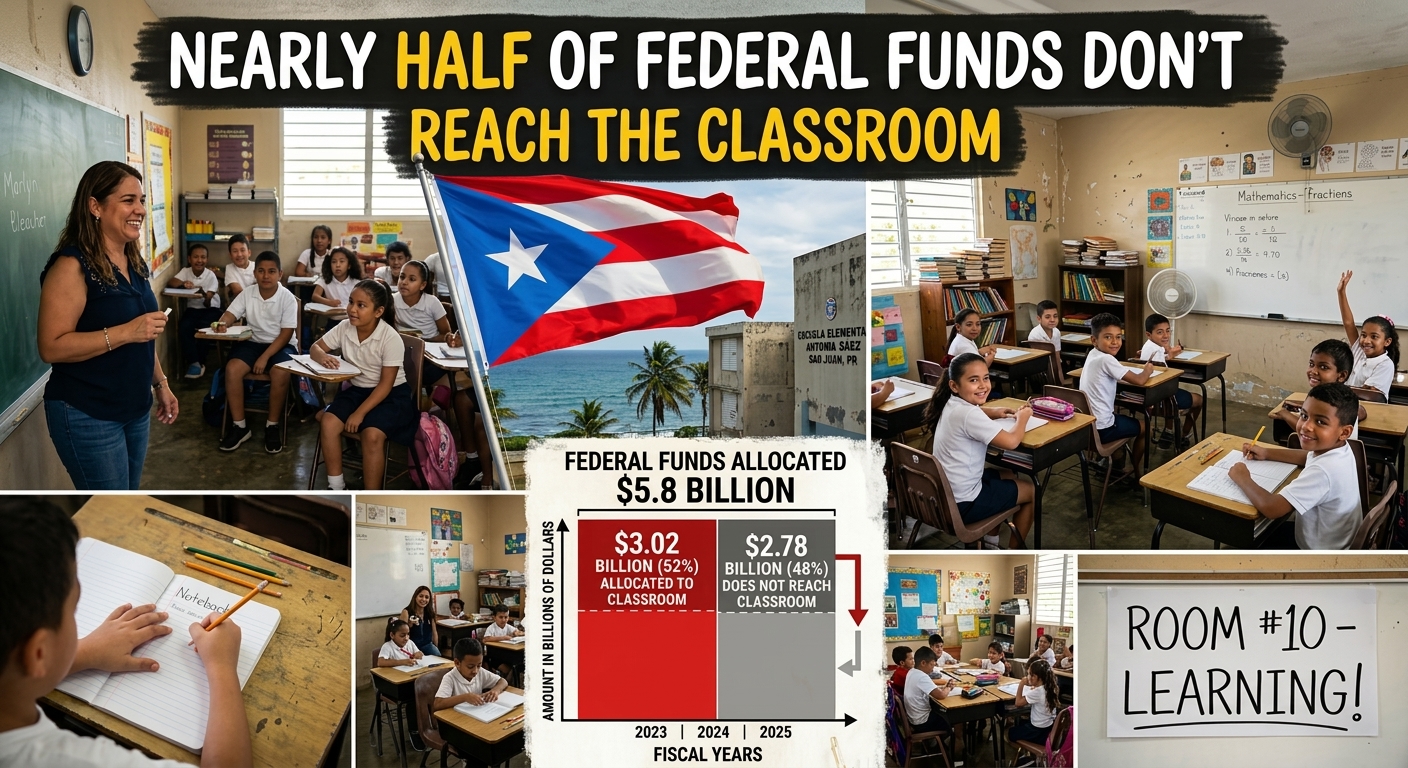
Every federal dollar that arrives in Puerto Rico to educate our children should end up in a classroom. It does not end up there. For every hundred federal dollars the Department of Education receives, nearly forty-five are consumed by administrative positions and external contracts that do not teach anyone to read, do not correct an essay, and do not help a student understand a text in Spanish or English. Read that again: 45%. Almost half of the money Congress allocates for Puerto Rico’s students stays in central offices, regional offices, political appointments, and service contracts that do not touch a student’s academic life.
A System That Feeds on Itself While student enrollment has dropped by half in a decade, the administrative apparatus has not shrunk proportionally. Offices, regions, facilitators, committees, and external contracts continue to grow. Each structure requires its own staff, its own budget, and its own justification to exist, and that justification is almost never measured by what a child learns. We all know the result. Students moving up grades without mastering reading. Young people graduating without understanding what they read. Schools with overcrowded classrooms and exhausted teachers, while offices have a surplus of desks, reports, and meetings. It is not a lack of money. It is a matter of where the money goes.
A Rule That Already Exists in Other Federal Programs The federal government already knows how to impose spending discipline when it wants to. Head Start programs operate under strict caps on administrative costs and under simple, standardized systems of documentation and accountability. If a program that serves thousands of young children can operate with a lean structure, there is no reason a department with billions of dollars cannot do the same. That is why we request that the federal government intervene requesting immediate changes in the Puerto Rico Department of Education and do so with clear instructions:
- Limit administrative spending in the Department of Education to 5% of federal funds received.
- Automate bureaucratic functions through artificial intelligence and more cost-effective, less repetitive systems: payroll, attendance, enrollment, compliance reporting, procurement processing, and record archiving. Today, these tasks occupy entire offices. A well-designed system executes them in seconds and at a fraction of the cost.
- Reduce external contracts that have no direct connection to teaching, and subject the remaining ones to public audit.
- Require all released funds to be reinvested in the classroom.
- Make sure that what is classified as academic spenditures relates directy to the student academic performance.
- Immedialety cancel all tutoring contracts en use the fund to hire more reading teachers for the classroom.
Where the Money Must Go: Teachers and Small Class Sizes Cutting bureaucracy is not an end in itself. The savings have an obligatory destination: learning.
- More teachers per classroom. Two trained adults in the same group make it possible to attend to each student’s needs, support those falling behind, and challenge those who excel.
- Class sizes capped at 15 students. With 15 children, a teacher knows each one by name, listens to them read, detects early on who is struggling to understand, and corrects the issue before it turns into a lifetime of functional illiteracy. With 30 or more, that is impossible.
- Real measurement of progress, ensuring no student advances to the next grade without demonstrating mastery of reading and comprehension.
Language as the Center of Everything If a single priority must be chosen, let it be this: that every student learns and comprehends languages. Anyone who does not master their language cannot study mathematics, science, or history, nor can they understand a contract, a law, or the news. That first includes Spanish, the native language of the island, and then English, as a tool for access to higher education, employment, and the global economy. The emphasis must be on comprehension, not mechanical repetition: reading, interpreting, reasoning, writing, and conversing. With class sizes of 15 and two teachers per classroom, students practice reading aloud, discussion, and writing every day with immediate feedback. That is how a language is truly learned.
What Is at Stake With every passing year without fixing this, thousands of children lose the opportunity to learn to read on time. That loss cannot be recovered through a report or a committee. A country that spends nearly half of its education funds on administration while leaving its children unable to comprehend what they read is paying for its own failure. The federal government has the authority, the responsibility, and the tools to demand something better. Let it cap administrative spending at 5%. Let it order the automation of what does not require bureaucracy. Let it direct every dollar saved toward more teachers, class sizes of 15, and language instruction and comprehension. The children of Puerto Rico cannot wait for another generation of promises. Today, they need a classroom where someone teaches them. We ask the state and federal governments to please cap administrative processes and expenses at 5% so that more goes to the student.
https://apnews.com/article/head-start-trump-rfk-standards-18693283cd6791f43e9c181363229a77

