

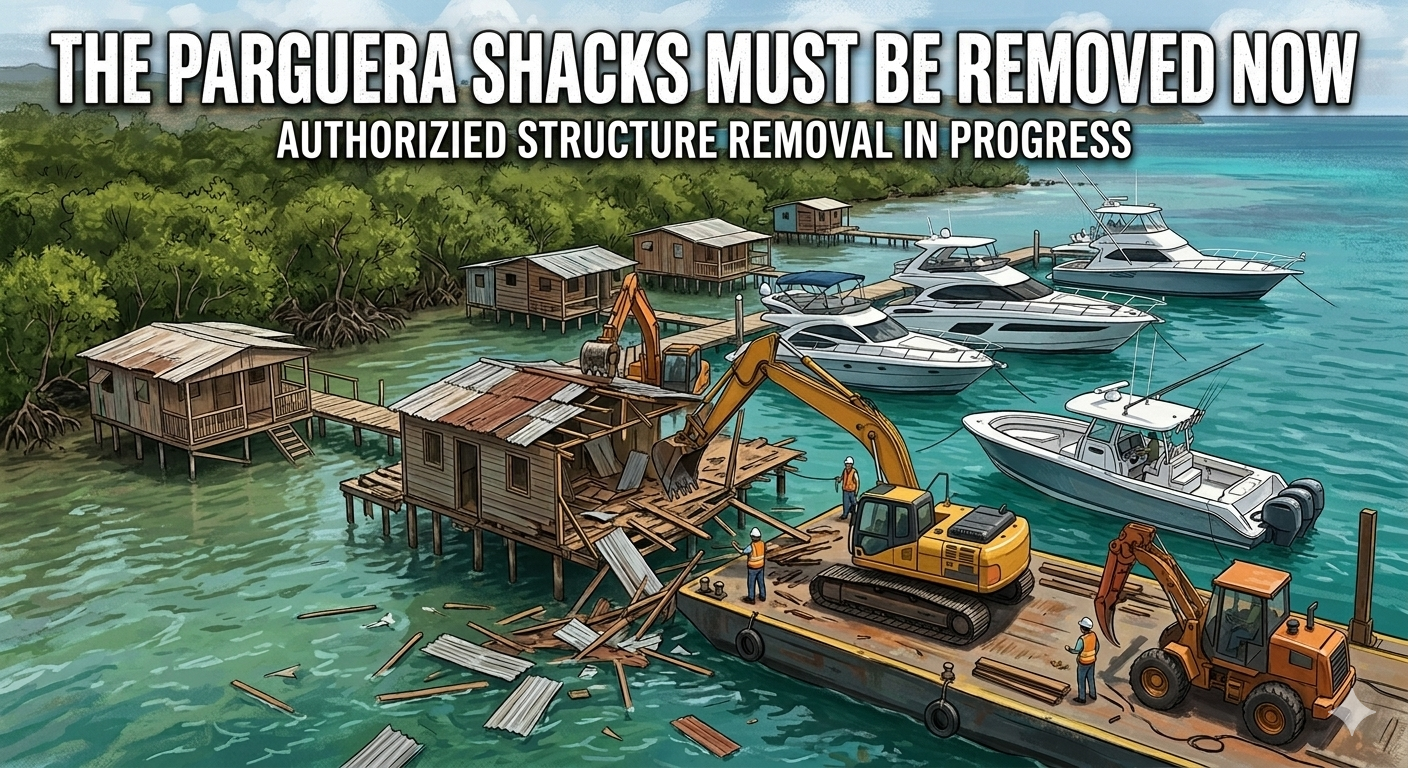
The coastline of La Parguera, in Lajas, is not only one of Puerto Rico’s most important ecological treasures — it is also the setting for one of the most prolonged and normalized violations of the law in our recent history. What some call “traditional vacation cabins” are, under the law and in the eyes of the ecosystem, illegal structures occupying public domain property.
Maintaining these structures is not a matter of culture or tradition — it is a matter of impunity. Below are the legal and environmental reasons why the only just course of action is their removal.
1. Violation of the Ports and Harbors Act and the Public Domain
Under the Puerto Rico Ports and Harbors Act of 1968, the maritime-terrestrial zone is public domain property. This means it belongs to the entire people of Puerto Rico and cannot be subject to private ownership, sale, or adverse possession (ownership acquired through prolonged use).
The argument: The shacks are embedded in territorial waters and submerged lands that, by law, must be freely accessible to all. By allowing their continued existence, the State is granting exclusive use of a public resource to a privileged few — violating every citizen’s constitutional right to enjoy our coastlines.
2. Non-Compliance with DRNA Regulation 4860
Regulation 4860 of the Department of Natural and Environmental Resources (DRNA) governs the use and oversight of the maritime-terrestrial zone. This regulation is clear:
- Any permanent or non-removable construction in these zones requires a concession — one that the majority of these structures do not possess, or that expired decades ago.
- The DRNA has recently acknowledged that these structures “are not legal,” which invalidates any attempt to claim acquired rights over the space.
3. Environmental Crimes and the Federal Clean Water Act
The situation at La Parguera does not only violate local laws — it also violates federal law. Recent investigations have identified possible violations of the Federal Clean Water Act due to:
- Illegal discharges: Many of these structures lack adequate sewage systems, discharging gray and black water directly into the marine ecosystem.
- Mangrove destruction: Cases of mangrove clearing to expand these structures have been documented, which constitutes a crime under Puerto Rico’s conservation laws. Mangroves are our first line of defense against hurricanes and the home of countless species.
4. The Danger of a “Legalization” Precedent
There are currently legislative efforts to “regulate” or grant 40-year licenses to these illegal occupations (such as House Bill 269). Legalizing the illegal sends a damaging message to society: that in Puerto Rico, if you violate the law long enough and have the right political connections, you will eventually be rewarded with title to what was stolen.
The Puerto Rico Senate’s decision to reject the measure to legalize the La Parguera shacks marked a milestone in the island’s environmental policy. Senate Bill 1314, which sought to create the “Act for the Regularization of Concessions for Floating Houses and Shacks at La Parguera,” was ultimately discarded after intense public and technical pressure concluded that the measure was legally untenable. This means the illegal shack belonging to the in-laws of Governor Jennífer González must be removed immediately, along with all the others in the area.
Applicable Fines Under the Current Legal Framework
The current legal framework permits — and in theory requires — the imposition of fines for the following reasons:
1. Direct Environmental Violations
Shacks that lack adequate waste management systems are committing serious environmental crimes:
- Illegal discharges: Dumping gray or black water directly into the sea or mangroves carries fines of up to $25,000 per day of violation under federal law (Clean Water Act).
- Habitat destruction: Mangrove pruning to expand these structures, or illegal anchoring over coral reefs, are direct grounds for substantial administrative fines.
2. Illegal Occupation of Public Domain Property
Since the regularization law was not approved, any structure in the maritime-terrestrial zone without a valid concession constitutes an invasion of public property:
- The DRNA has the authority to issue Cease and Desist orders.
- Fines may be imposed for the use and enjoyment of space belonging to the entire people of Puerto Rico without paying the corresponding fees.
Obstacles to Enforcement
Despite the clarity of the law, enforcement has been intermittent for decades due to:
- Insufficient Rangers: The DRNA has limited human resources to patrol and individually document each violation.
- Prolonged Litigation: Many shack owners have the financial resources to hire attorneys who drag out fine and demolition proceedings in the courts for years.
Relevant note: Recently, public pressure has forced the resumption of “environmental crime” cases at La Parguera, where fines have been issued not only for construction violations, but also for altering water flow through mangrove channels.
Conclusion
Protecting the La Parguera Nature Reserve requires political courage. This is not about targeting individual families — it is about restoring the rule of law. The demolition of illegal structures is the first step toward healing our coastline, protecting the biodiversity of the Bioluminescent Bay, and returning to the people what the law says is rightfully theirs.
References
- Puerto Rico Ports and Harbors Act of 1968.
- DRNA Regulation 4860 for the Use, Oversight, Conservation, and Administration of Territorial Waters.
- Federal Clean Water Act.
- Reports from the University of Puerto Rico at Mayagüez (UPRM) on water quality deterioration at La Parguera.

