
When the System Fails Its Children
“The school is the only instrument of redemption for peoples.” — Eugenio María de Hostos (1839–1903)
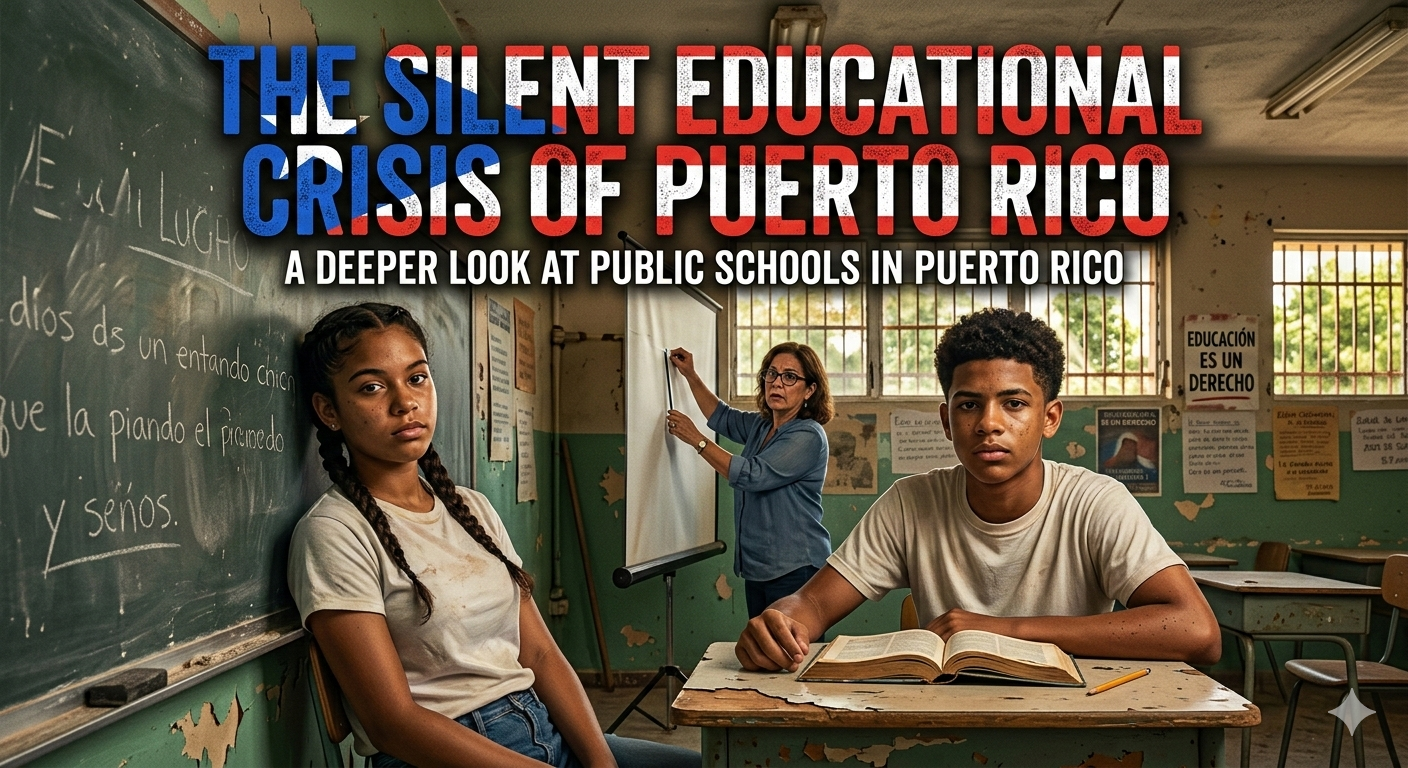
Hostos saw it with crystalline clarity more than a century ago: without genuine schooling, there is no free people. Puerto Rico, however, has spent decades building a system that bears the name of education but serves purposes radically different from those the great Puerto Rican teacher envisioned. What exists today is not an educational system — it is a political apparatus disguised as a pedagogical institution, and its most silent victims are the boys and girls who every morning walk into schools abandoned by the State that was supposed to protect them.
The System as a Political Machine
The Puerto Rico Department of Education is not, in its actual function, a pedagogical institution. It is, above all, a power structure. With more than 30,000 employees on its payroll and a budget that has historically exceeded $5 billion annually, the Department became, decades ago, the perfect agency for rewarding partisan loyalties, placing allies in administrative positions, and distributing million-dollar contracts among the same campaign contributors who decide who governs.
Every change of administration brings a new wave of appointments. Advisors without pedagogical credentials. Secretaries whose greatest qualification is their closeness to the governor of the moment. Contracts for technology firms, legal services, consulting agencies, and educational materials that compete not on merit, but on connection. The child in the classroom is, in this scheme, the last in the chain of consideration.
This pattern is neither new nor accidental. The Puerto Rican historian and educator Aníbal Díaz Quiñones already warned that colonial institutions tend to reproduce hierarchies of control rather than spaces of intellectual liberation.¹ The Puerto Rico Department of Education has proven, in its recent history, to be a textbook case of that institutional pathology.
The Vision of Hostos Betrayed
Eugenio María de Hostos dedicated his entire life to the cause of education as an instrument of emancipation. For Hostos, educating was not transmitting information — it was forming free consciences, citizens capable of governing themselves and their society with reason and justice. In his work Moral Social (1888), he wrote with a clarity that resonates today as unfulfilled prophecy:
*”Peoples who cannot read or write are peoples condemned to be playthings of tyranny.”*²
The tyranny that Hostos feared did not arrive only in visible chains. It also arrived through manipulated budgets, through contracts without bidding, through regional offices that duplicate functions and consume resources that should have reached the classroom. It arrived with the normalization of a system that educates for dependency rather than autonomy, that forms passive consumers of clientelist politics instead of critical citizens.
Hostos founded schools in Santo Domingo and Chile when Puerto Rico was denied to him. He understood that the school was, in his own words, the only space where a colonized people could begin to build its dignity. Today, the school he dreamed of — free and transformative — has been turned into an instrument for perpetuating the very order he fought against.
The Bankruptcy as a Smoke Screen
Puerto Rico’s fiscal crisis and the restructuring process under PROMESA and the Financial Oversight and Management Board provided the perfect curtain. Public conversation shifted toward bonds, creditors, and budget cuts, while the pedagogical collapse continued without honest diagnosis or real accountability.
According to the 2023 report of the Financial Oversight and Management Board for Puerto Rico (FOMB), per-student spending in Puerto Rico is among the highest of comparable U.S. jurisdictions — without the academic results to justify that spending.³ The paradox is revealing: much is spent and little is taught, because a disproportionate share of the budget is consumed by the central bureaucracy before it ever reaches the school.
The debt did not arise on its own. It was built in part on a model of governance that prioritized the contract over the service, political employment over efficiency, and appearances over results. And while that debt is being negotiated, children wait. Without up-to-date textbooks. With exhausted and poorly compensated teachers. In deteriorating buildings. Without the technological resources that the 21st century demands.
The Abandonment of Puerto Rican Children
The figures are devastating and cannot be hidden indefinitely. According to the National Assessment of Educational Progress (NAEP), known as The Nation’s Report Card, Puerto Rico’s students consistently score the lowest among all participating jurisdictions in reading and mathematics.⁴ In fourth and eighth grade tests, proficiency levels in Puerto Rico do not reach 20% in either of the two core subjects — a statistic that in any functioning democracy would generate a first-order state crisis.
The school dropout rate in Puerto Rico, estimated between 20% and 30% depending on the methodology used, directly feeds economic marginalization.⁵ And economic marginalization, as human history demonstrates without exception, feeds crime. This is not moralism — it is documented causality. According to the Puerto Rico Institute of Statistics, there is a direct correlation between municipalities with lower school retention rates and those with higher rates of violent crime.⁶
Every young person the system abandons is a social cost that the island pays in violence, in incarceration, in truncated lives, in human potential wasted forever. This is the greater crime — not the one that occurs in the streets, but the one that is silently planned in the hallways of the central offices where the fate of education is decided without a single child represented at the table.
A Crisis That the Government Conceals
The most disturbing aspect of this crisis is not its existence — it is its deliberate invisibility. Successive governments, regardless of party, have developed a sophisticated art of appearing to reform without actually reforming. New curricula are announced that never reach classrooms. Technologies are promised that remain as unfulfilled contracts. Secretaries with academic credentials are celebrated in appointments while the underlying clientelist structure remains intact.
Political scientist Carlos Pabón has noted that the Puerto Rican two-party system has historically used government agencies as extensions of the partisan apparatus, turning public service into electoral reward.⁷ No agency illustrates that phenomenon more clearly than the Department of Education, where thousands of positions, contracts, and administrative decisions follow the logic of political patronage rather than the logic of the common good.
The bankruptcy process offers no escape from this dynamic because the bankruptcy is fiscal, not moral. The same political actors who built the debt continue to administer the institutions, now with the convenient alibi that “the Board’s cuts” prevent transformation. It is a comfortable narrative that relieves of responsibility those who bear it most.
The Real Remedy: Decentralize, Democratize, Return
If the problem is structural, the solution must be as well. This is not about reforming what exists — that cycle has failed repeatedly. It is about dismantling the centralized model that makes abuse possible and replacing it with one that returns power and resources to where they belong: the school, the teacher, the student.
The proposals that administrative logic and comparative experience suggest are straightforward:
Close the Central Office and Regional Offices. These structures do not serve the student — they serve the political system. They are layers of administration that consume resources, generate bureaucratic dependency, and distance decision-making from the reality of the classroom. Countries like Finland, frequently cited as a world educational model, have demonstrated that radical decentralization — with real authority in the hands of principals and teachers — produces results superior to any centralized model of bureaucratic control.⁸
Direct funding to schools. Money designated for academics must reach the school without intermediaries. Principals with real authority, budgets assigned by enrollment and need, and direct accountability to the school community. When resources reach their destination without passing through ten hands, more arrives and it arrives better.
External services should remain external. Psychologists, social workers, therapists, and other support professionals can provide services to schools without being absorbed into the Department’s central payroll. The model of specialized services attached to corresponding agencies is more efficient, more measurable, and less susceptible to political patronage.
Suspend transfers to other government dependencies. The education budget must be untouchable for purposes unrelated to education. The historical transfers that have drained the educational budget to cover other governmental needs represent a direct violation of Article II, Section 5 of the Constitution of the Commonwealth of Puerto Rico, which guarantees the right to an adequate education.⁹ They must cease by law, with real penalties for those who authorize them.
Conclusion: The Greatest Debt Is Not Financial
Puerto Rico faces a moral debt to its children that does not appear in any PROMESA balance sheet. It is the accumulated debt of generations sacrificed on the altar of political clientelism. It is the debt of every inflated contract that could have been a science laboratory, every unnecessary position that could have been a teacher’s raise, every cosmetic reform that could have been real transformation.
Hostos also wrote that *”he who educates, liberates.”*¹⁰ Puerto Rico has inverted that equation for far too long: he who administutes education as political spoils, enslaves. He enslaves the child to ignorance, the community to dependency, and the entire country to a cycle of crisis that feeds on itself.
Puerto Rico’s educational crisis is not the result of fate or of the colonial condition alone, although the latter provides it with undeniable historical context. It is the result of concrete decisions, made by concrete people, who chose personal benefit over the collective good. Changing that requires a political courage that the current system does not incentivize — which is why change will not come from the system. It will have to come from civil society, from parents, from teachers, and eventually from the very young people the system abandoned, who one day will demand what they were owed from the beginning.
The education of a people is not a government service. It is the foundation of its existence as a free community. Hostos knew this. Puerto Rico has forgotten it. And that forgetting has a name, has accomplices, and has consequences that we can no longer continue to ignore.
Complicit silence is also a form of abandonment.
References
¹ Díaz Quiñones, Aníbal. El arte de bregar: Ensayos. Ediciones Callejón, San Juan, 2000.
² Hostos, Eugenio María de. Moral Social. Imprenta de J. Cunill, Santo Domingo, 1888. Reproduced in Obras Completas, Volume XVI, Instituto de Cultura Puertorriqueña, 1969.
³ Financial Oversight and Management Board for Puerto Rico (FOMB). Fiscal Plan for Puerto Rico. Certified May 2023. Available at: https://juntasupervision.pr.gov
⁴ National Center for Education Statistics. NAEP Report Card: Puerto Rico. U.S. Department of Education, 2022. Available at: https://www.nationsreportcard.gov
⁵ Puerto Rico Institute of Statistics. Report on School Dropout in Puerto Rico. San Juan, 2021. Available at: https://estadisticas.pr
⁶ Puerto Rico Institute of Statistics. Public Safety Indicators and Socioeducational Correlations. San Juan, 2022.
⁷ Pabón, Carlos. Nación postmortem: Ensayos sobre los tiempos de insoportable ambigüedad. Ediciones Callejón, San Juan, 2002.
⁸ Sahlberg, Pasi. Finnish Lessons: What Can the World Learn from Educational Change in Finland? Teachers College Press, New York, 2011.
⁹ Constitution of the Commonwealth of Puerto Rico, Article II, Section 5. Approved July 25, 1952.
¹⁰ Hostos, Eugenio María de. Cited in Maldonado Denis, Manuel. Eugenio María de Hostos: Sociólogo y Maestro. Editorial Antillana, San Juan, 1981, p. 47.

